
Detailed Explanations
How PLANTONIC electroculture works: the process, benefits, applications and compatibility with other farming techniques.
Detailed explanations
PLANTONIC electroculture
PLANTONIC devices increase soil fertility by injecting low-power electrical charges via electrodes. The goal is to regulate and slightly amplify the natural electrical currents flowing through the soil.
The injected electricity takes the form of special electronic signals, generated by a circuit developed in our R&D office. Power comes from one or more photovoltaic panels mounted on the PLANTONIC unit or placed a few metres away.
Benefits of electroculture
By stimulating the soil as we do, we act on the substrate, not on the plant. Our action serves to increase and regulate natural electro-bio-chemical reactions. By amplification, it positively modifies soil structure and the flora and fauna living in it. Bio-available nutrient production in the rhizosphere increases. This larger quantity of nutrients benefits plants and lets them grow more (simplified explanation).
Observations show:
— Greater plant growth, excellent health. Defence strategies against predators activate. The plant resists attacks much better. Fruits are higher quality with greater vitality, more flavour and larger size. Seedlings grow faster, with about 8 to 15 days’ head start.
— Plants are bigger. The variation can exceed 100% in greenhouses.
— Plants are healthy. No need for pesticide treatments.
By letting nature work, using natural organic amendments is enough to “recharge” the soil. No more chemical-fertiliser inputs needed.
Organically, fruits or roots are more natural. They’re guaranteed pesticide-free with far fewer predator attacks.
Taste-wise, fruits are more flavourful. The biophoton level is much higher (see “booster” page) — biophotons represent vitality.
Financially, the savings on industrial products easily offset the investment in our equipment, which is bought for many years. For a 700m² surface, the investment is between €500 and €700 and includes a PLANTONIC, two copper-tube electrodes, some electrical wire and easy setup.
The PLANTONIC process
The PLANTONIC process consists of placing electrodes on either side of the plot to stimulate. The electrodes are placed along the EAST-WEST axis. These two electrodes define a rectangle formed by the East and West electrodes. Sides can be up to 50m long (Plantonic 1000).
The electrodes are connected to an electronic module that generates special signals with power matched to the surface. This generator is powered by a photovoltaic panel for electrical autonomy. The device respects the plants’ day-night cycle.
The product range goes from 1m², 50m², 300m², 1000m² across 4 devices. Other ranges for surfaces up to 2,000m², 5,000m² and 10,000m² are in development.
PLANTONIC limitations
Today our research doesn’t yet allow working on large surfaces above 1,000m² with these technologies. We’re working on new, less limiting concepts for 2026.
PLANTONIC range in 2025
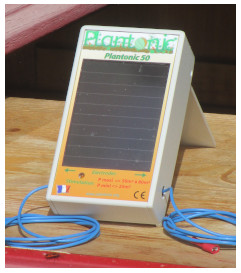
Plantonic MINI
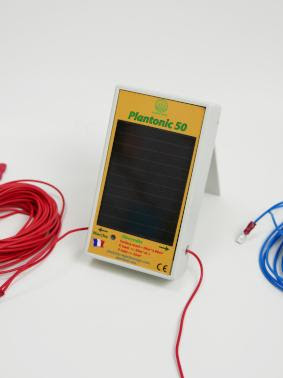
Plantonic 50M²
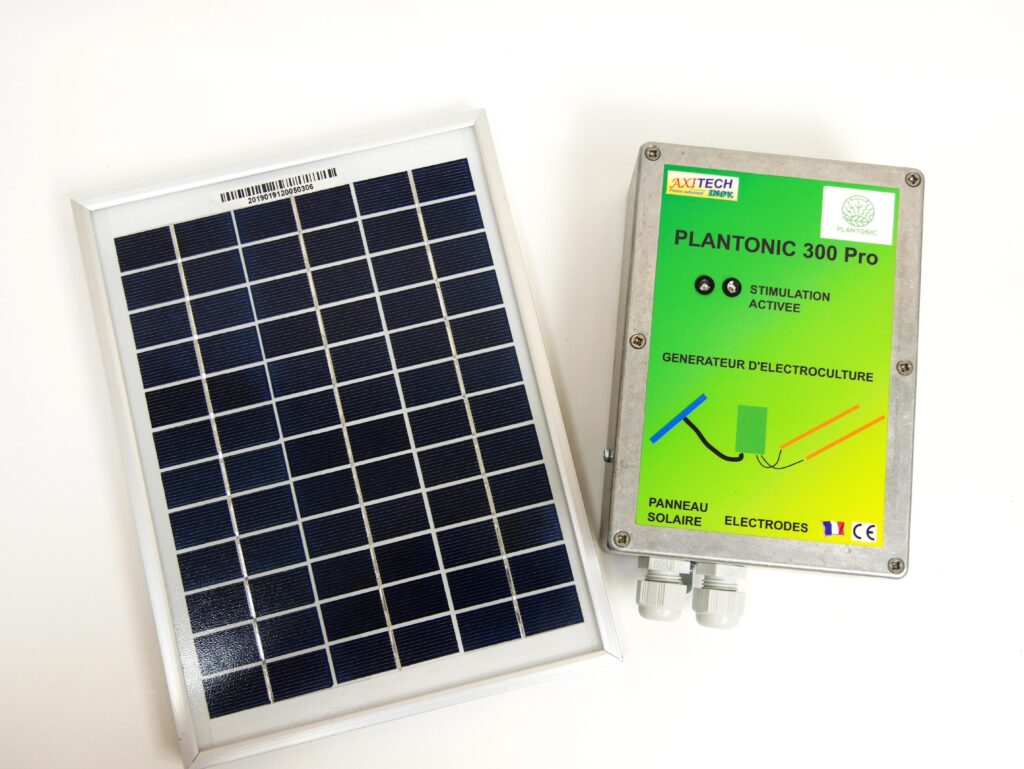
Plantonic 300PRO
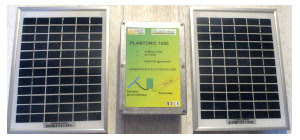
Plantonic 1000
PLANTONIC applications
The applications of these devices are numerous:
• Seedling development in window boxes.
Plantonic strongly stimulates seed growth. They deliver vigorous seedlings with faster emergence — about 8 to 15 days earlier.
• Open-ground stimulation.
The Plantonic 50m², 300m² and 1000m² can stimulate vegetable gardens of these sizes. Growth is greater, plants more vigorous, harvests abundant, and fruit quality superior to organic products (see ENERLAB study). Plants resist diseases and predators much better.
• Help for new plantings.
Trees, shrubs or plants — the Plantonic stimulates rooting and recovery of new plantings.
• Care of sick plants:
The Plantonic can heal a plant or tree so it regains vigour.
• Increased active ingredients and EOs in aromatic plants.
A 20% to 30% gain is possible.
Same for plants used in phytoremediation, which fix heavy metals in their stems and leaves.
Compatibility with other farming techniques
Electroculture and permaculture:
Electroculture energises permaculture. Permaculture is based on planting seeds or seedlings on decomposing matter that becomes compost. This slow, continuous decomposition, with regular inputs, makes high-quality nutrients available. Plants grow strongly with excellent fruit quality. With these nutrients in large quantity, you can plant another plant as soon as a slot opens. No risk of substrate depletion. Production is constant and abundant nearly all year.
Electroculture combined with permaculture energises decomposition even more, and thus nutrient creation. This maximises plant growth and health. The process notably increases production quality and quantity.
Electroculture and biodynamics:
Electroculture energises the active ingredients and preparations used in biodynamics. Electroculture has a positive action that can be strongly amplified by our BOOSTER. Biodynamics uses information from preparations to energise plants and soil. As in homeopathy, information spreads while matter dilutes. By this principle, high dilutions remain just as active. The electroculture we develop puts in place techniques that go beyond electromagnetic phenomena. This technique stimulates information processing at the plant level.
Our process has nothing to do with the old electroculture techniques using poles placed in fields, whose effectiveness was proven in the early 1900s.
Electroculture and magnetoculture:
Our Plantonics use natural magnetic forces. The electrodes are placed along the EAST-WEST axis. Earth’s magnetic field sits on the NORTH-SOUTH axis. On the soil, the electric field is perpendicular to the magnetic field. Laplace’s law shows that a force is induced on the vertical axis. This force acts on the plant and pushes sap up or down. The direction of the electric current defines the direction of the force.
Magnet use accounts for Earth’s magnetic field. An artificial field adds to or opposes the natural magnetic field. Trials in various configurations and with magnets of different strengths must be tried to find the best solution.
An experiment done in 2025 shows that Laplace’s law indeed acts on plants — it will be published on the site soon.
Tomato disease
Current news (2020) informs us of a viral disease in the greenhouses of some market-gardening operations in Finistère.
Everyone could be impacted — even amateur gardeners who might get infested plants from garden centres.
Starting your own seedlings should guarantee avoiding sick plants.
Our observations have shown that electroculture stimulates plants. They become healthier and know how to defend against attacks from predators or diseases.
Diseases
Diseases are few in electroculture. Except in extreme weather. Common vegetable diseases (rust, blight or aphid attacks and other insects) don’t appear or very little. They don’t destroy plants or fruits.
The reasons are linked to plant health — they find within their metabolism the means to heal. Heatwave damaged some leaves which dried out. That’s a way for the plant to balance its sunlight needs by shedding leaves. However fruit production and quality weren’t impacted.
You can however notice growth difficulties during seedling or transplanting. This phenomenon is well detailed in gardening sites. It comes from a difference between the growing conditions of parent plants that produced the seeds. The startup of seedlings to transplant is a second important cause. Epigenetics offers an answer through different growing methods that imprinted the seeds or seedlings (fertilised potting compost, greenhouse growing…).
This lack of growth fades after a few days.
No visible results
During some tests, stimulated plants were identical to control plants. This doesn’t let us conclude on electroculture’s effectiveness.
The reasons are multiple.
— The PLANTONIC wasn’t well positioned in full sun, and for part of the time shade blocked the solar cells.
— The compost used was too rich in directly assimilable elements. This is the case for transplanting composts loaded with fertilisers. They completely skew the test, since plants have a large quantity of readily-assimilable elements at their disposal. In that case, stimulation is useless. For a test, take natural vegetable-garden soil.
The challenge of electroculture is to have greater growth and harvests with stimulation. The control in the “witness” part lets us quantify these differences.