
The Booster
Born from our research on shape waves, this discovery delivers growth of over 200% compared to control plants.
Booster
A leap forward in our research: the BOOSTER
Born from our research on shape waves — a field labelled “pseudo-science” by the enlightened scholars of “serious” science. (For more information, see my latest book “Information, engine of the universe”, published January 2024).
By combining electroculture with our Booster, our first tests in planters showed over 200% growth between a control plant and an electrocultivated + boosted plant. Other trials are underway on larger surfaces and show greater plant growth in size, volume and harvest. This discovery, born from deduction and serendipity, allows the booster to be used successfully on surfaces of several hundred m².
How does it work?
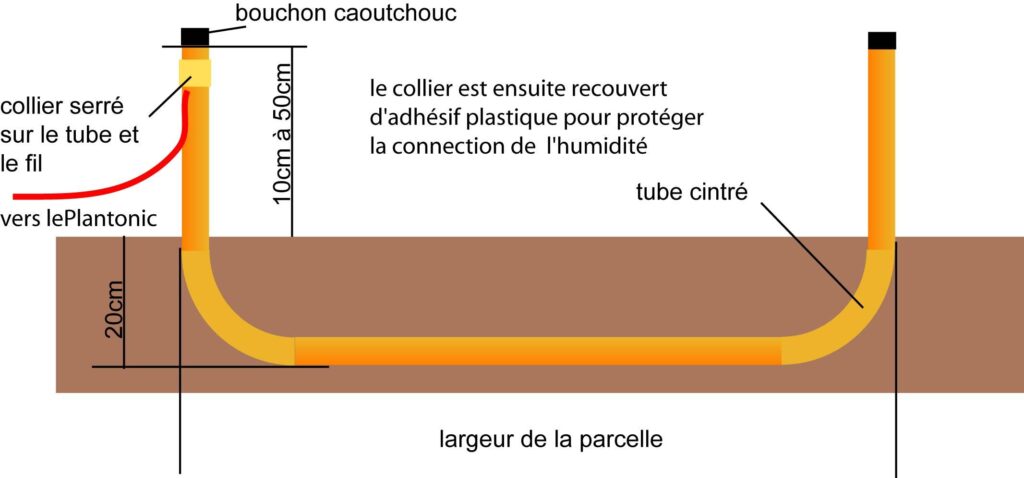
We modified the electrodes that delimit the stimulated plot. Copper tubes are rolled out (work-hardened plumbing tubes 12/14, sold in rolls) into the two 20cm-deep trenches, then the ends are bent upwards. These tubes replace the old steel sheets connected by electrical wires. The tube ends stick out of the soil — this makes them easy to find and ensures connection with the PLANTONIC unit via an electrical wire (see the PLANTONIC installation guide).
A concentrated Booster solution, delivered with the PLANTONIC, fills the tubes. A top-up of demineralised water completes the liquid up to a few centimetres from the top of the tube. Each tube is sealed at both ends. No direct contact exists between the liquid and the soil around the tube. During installation, the soil is packed down and watered to ensure good contact with the copper.
What happens?
The PLANTONIC does its job and sends the electrical flow into the soil between the two electrodes. The electrical stimulation also carries the information from the copper and the Booster molecules across the whole plot. The Booster placed in the tube is only about 100 millilitres. The liquid stays in the tube permanently. Observation unambiguously shows that growth is significantly higher, as the photos below demonstrate. The Booster’s operation has no time limit. I won’t go further into technical explanations — the goal isn’t to confuse the uninitiated reader with concepts that already perplex conventional scientists.
Order the Plantonic Booster
To place an order or get further information about the Plantonic Booster, contact us directly by phone or email.
The Plantonic Booster is designed to support your crops and electroculture experiments. We handle each request individually to tailor the solution to your vegetable garden (surface, plant types, growing conditions, orientation North/South/East/West).
When you get in touch, you can tell us:
- The type of cultivation (vegetable garden, orchard, ornamental garden, container growing, etc.);
- The surface and plan of your project;
- Your goals (vigour, flowering, yield, experimentation, education…).
We’ll send you a free study for placing the Plantonic and electrodes, plus usage recommendations for the devices and the Plantonic Booster.
Observations and experiments
Observations in greenhouse planters with vegetable-garden soil:
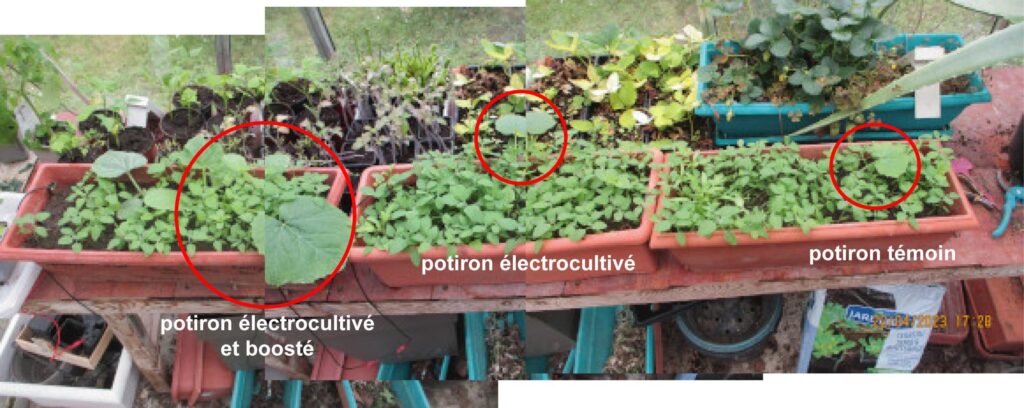
We placed three planters in the experimental greenhouse, all under the same conditions. From left to right: the electrocultivated + boosted planter, the electrocultivated one, then the control planter. Planting was done in early April. After 15 days, the pumpkin seeds had developed and showed significant differences in leaf growth. We measured leaf width in mid-May.
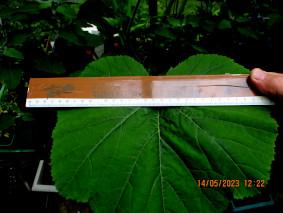
Electrocultivated and boosted pumpkin — largest leaf diameter: 27cm.
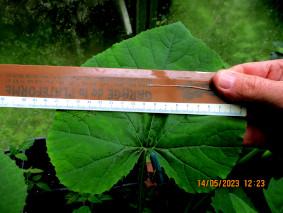
Control pumpkin — largest leaf diameter: 17cm.
We took measurements on the same day, at the same time. The ratio between the two diameters is 27cm/17cm = 1.59. The boosted pumpkin’s leaf is nearly 160% wider than the control pumpkin’s leaf.
Observations in the 400m² experimental vegetable garden, electrocultivated and boosted:
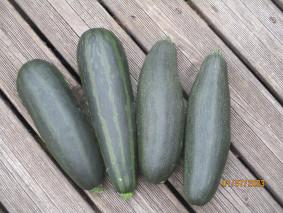
We harvested the courgettes in late June and early July, planted in May. They came from standard-size shop plants, length and diameter. Their dimensions: L 30 to 36cm, diameter 10 to 11cm, weight 1.3 to 1.8kg. These are courgette plants sold at garden centres — not larger marrow plants.
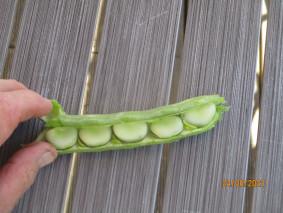
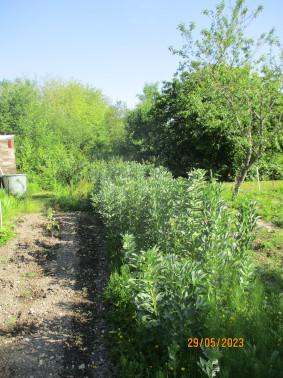
Broad beans, planted in October 2022, benefited from the Booster starting late April at the beginning of flowering. Their average height is 1.2m. The mid-June harvest from about sixty plants reaches 10.107kg — a record. The pods are 15 to 20cm long with 4 to 5 well-formed seeds.
Trial on large-scale farmland
The goal of this trial is to see whether boosted electroculture brings growth improvement in plants. The soil is completely damaged — nitrogen and other agro-chemicals are absolutely necessary. Production and disease control depend on these products.
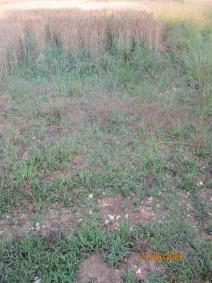
The soil was taken from a field with sparse vegetation. In the background, you can see the wheat with tightly packed stems. On the right are the grasses that benefited from nitrogen sprayed in the previous weeks.
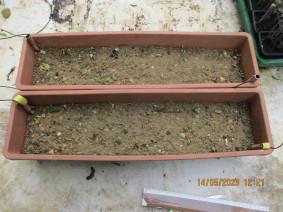
Two planters are filled with this clay-limestone soil. In the image above, the top planter is electrocultivated. The bottom one is electroboosted. We connect the four electrodes (small copper tubes in the corners) in series. They’re then connected to the PLANTONIC MINI to stimulate them the same way.
Evolution of pumpkin plant growth in damaged soil over several weeks
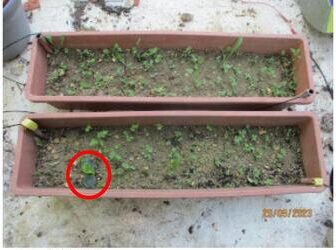
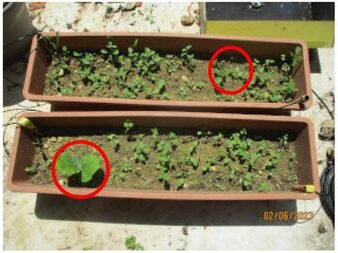
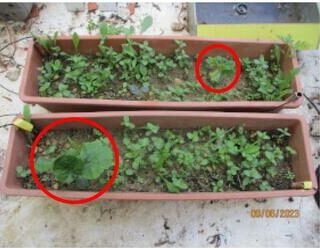
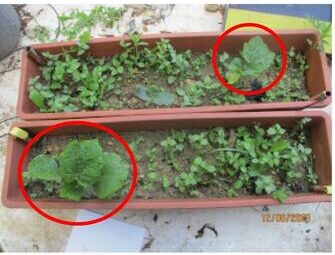
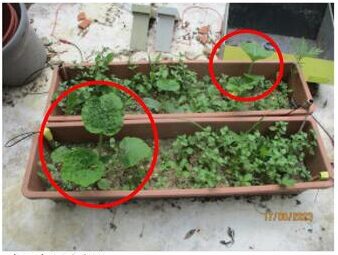
The various photos show the evolution of growth using electroculture and the Booster in a “dead” soil. Setting up a third “control” planter would probably not have caused a seed to germinate. We can hastily conclude that the Booster strongly activates fertilization. Plant growth is improved even in damaged soils. More extensive trials on large areas need to be undertaken and the Booster formulation needs to be optimized.
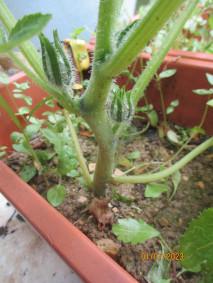
The photo above shows the stem of the electroboosted pumpkin, which is vertical and vigorous.
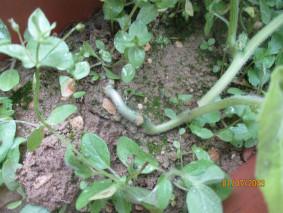
The photo above shows the stem of the electrocultivated pumpkin; it trails along the ground and its cross-section is thinner.
Measuring biophotons in tomatoes in 2023
We signed a contract with the ENERLAB laboratory in Nice. The goal is to evaluate the biophotons in our electroboosted tomatoes and in “control” tomatoes. These are located nearby (>5m on the EAST side) but outside the electrocultivated zone’s field. The study was extended to tomatoes sold in stores. This allows us to position our electroboosted tomatoes within the commercial offering.
Two methods were used:
- Measurement with a high-definition, high-sensitivity CCD camera
- Measurement with a high-sensitivity luminometer.
4 samples of electroboosted tomatoes labeled 1 to 4. 2 samples of conventional “control” tomatoes were tested, labeled 5 and 6. Then 10 samples of tomatoes bought in stores in Nice.
- They come from various origins: France, Spain, Morocco
- They come from organic and conventional farming,
- They are bought in hypermarkets, supermarkets and grocery stores.
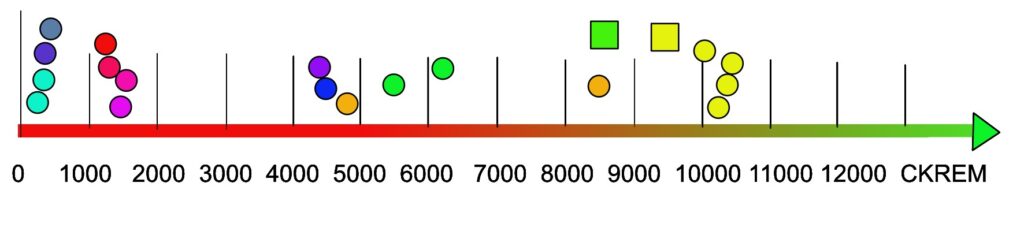
The results, shown as a graph below, are conclusive.
Measurement with a CCD camera
Measurement with a luminometer
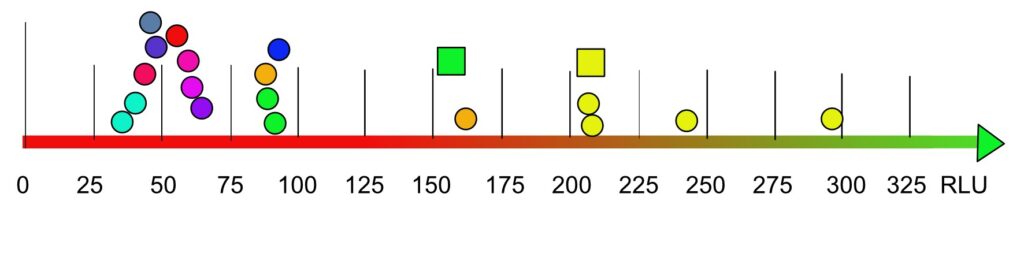
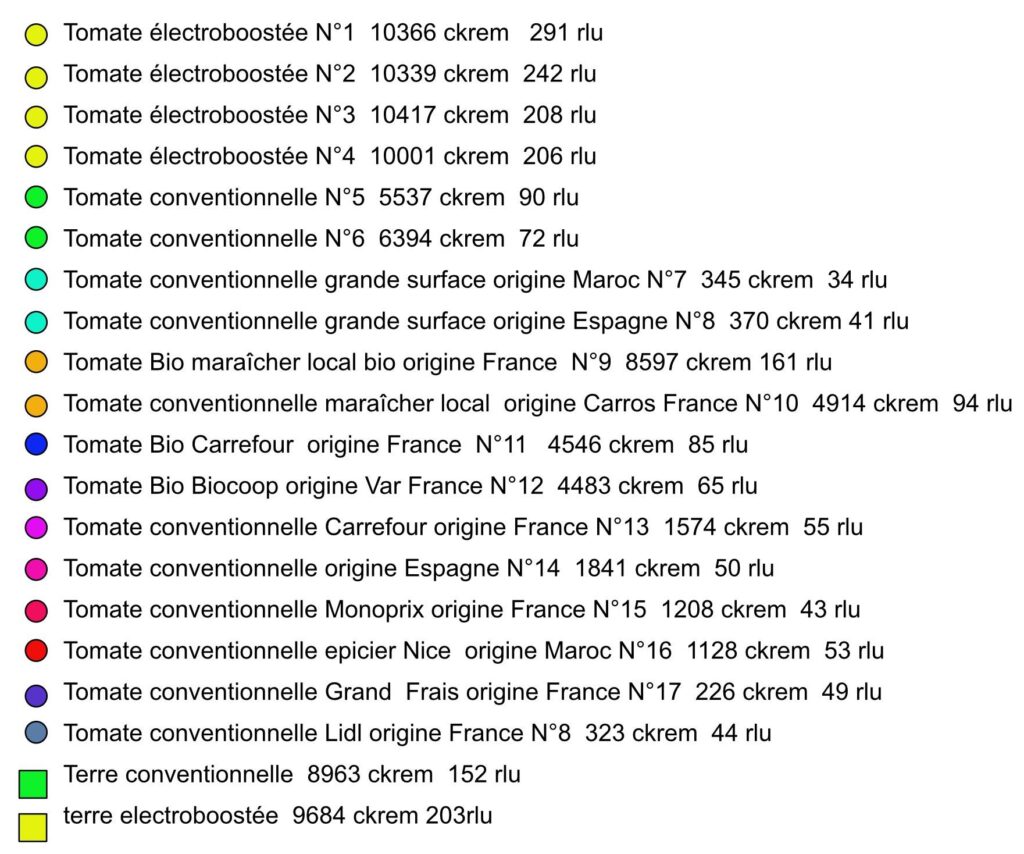
The difference between the electroboosted tomatoes and the conventional tomatoes is strongly distinguished. It shows, through both measurement methods, that biophotons are far more abundant in the electroboosted samples than in the “controls”. The number of biophotons is representative of the fruit’s vitality. This vitality is beneficial for our metabolism. The leading group, on the right, is made up of the 4 electroboosted tomatoes and the sample from the local organic market gardener.
The middle group includes our “control” tomatoes as well as the organic tomatoes from Carrefour, Biocoop and the conventional market gardener. The group on the left includes imported tomatoes, conventionally grown, although we do not have details about these growing methods. These tomatoes have undergone industrial treatments and probably irradiation to destroy pathogenic germs from the production site, to halt their natural decomposition and to keep their apparent freshness longer. However, their vitality has collapsed. We took advantage of these tests to analyze two soil samples coming from the electroboosted part and the conventional part. Their position on the graph is represented by the 2 yellow and green squares. Their position is consistent with the measurements made on the tomatoes.
Measuring biophotons in tomatoes in 2025
We had a new study carried out in 2025 by ENERLAB on 4 electroboosted tomatoes and 2 control tomatoes in a standard zone, measuring the quantity of biophotons in relation to the vitality and taste quality of the fruit. The results are shown below in the BIOPHOTONS study, along with a study on AMF, that is to say the ANALYSIS OF ARBUSCULAR MYCORRHIZAL FUNGI on the roots of the different tomato plants.
The biophoton measurement study shows that the 4 electroboosted samples are at the highest level of biophoton presence (red bars). The control samples are lower at 88% (green bars), the sample from an organic farm at 61% (light green) is lower still, and the industrial samples from Morocco and Spain are close to 11% of the electroboosted samples

Fruits with a high level of biophotons are of high quality for our metabolism and their taste sensations are excellent.
The comparison with the other samples shows the superiority of our electroboosted tomatoes even over the tomatoes from an organic farm (light green)
AMF: the presence of these fungi indicates the good health of the plant and the state of the interface between the roots and the soil. The samples from the electroboosted plants have a mycorrhization of 98.95%, a very high level, and the control samples have a mycorrhization of 21.63%, an average level
In conclusion, electroculture with the BOOSTER brings to the soil and to the plants an electromagnetic stimulation and an informational stimulation that make it possible to obtain very high quality products without the periodic application of treatment products. This reinforces the observation of healthier plants, which are therefore able to defend themselves against predators and disease while having better taste value, greater vitality and a higher yield. This had already been observed since the beginning of our trials, six years ago, through our observations and qualitative tests, without having precise measurements.
Observation of temperature resistance in tomato seedlings
Observation of tomato seedlings between September and December 2023. Temperatures gradually dropping to 0° in the greenhouse.
Seedlings sown on 29 September 2023 Beefsteak tomatoes
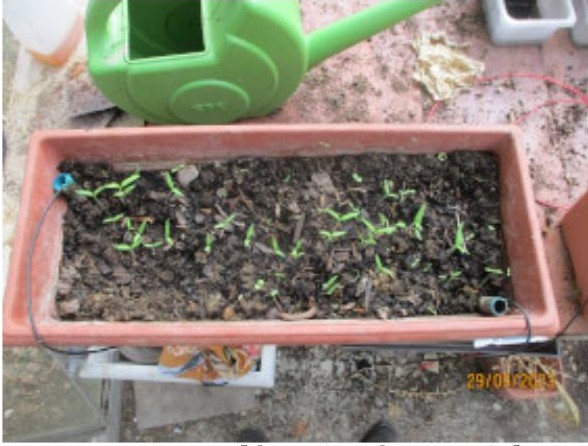
Electroboosted tomatoes
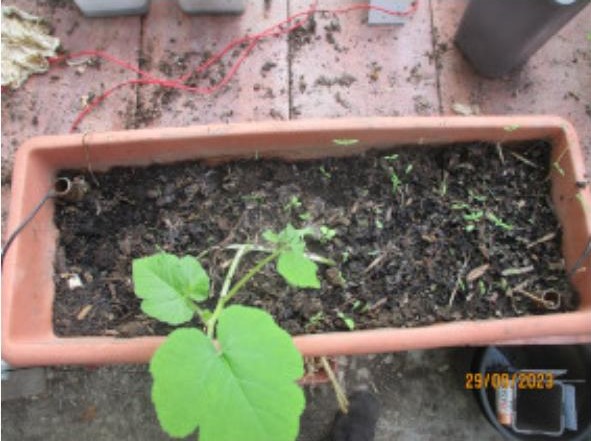
Electrocultivated tomatoes
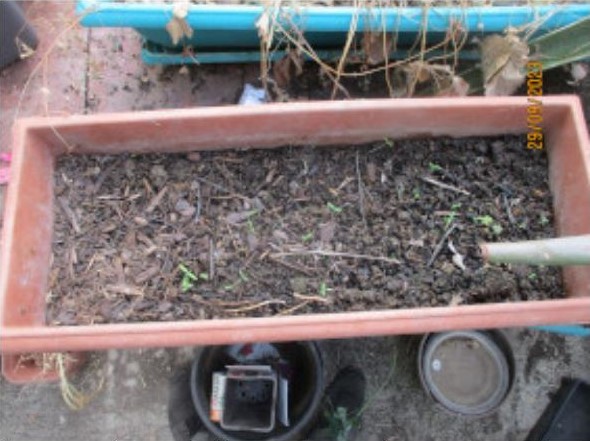
Standard control tomatoes
Disregard the leafy plant in the center planter
On 8 October, the seedlings developed significantly in the electroboosted and electrocultivated planters and were nonexistent in the control planter.
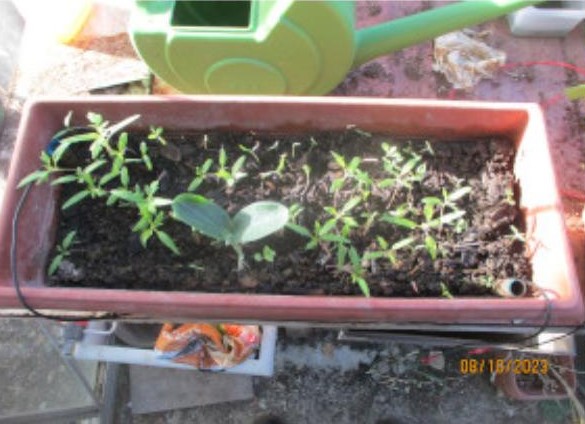
Electroboosted tomatoes
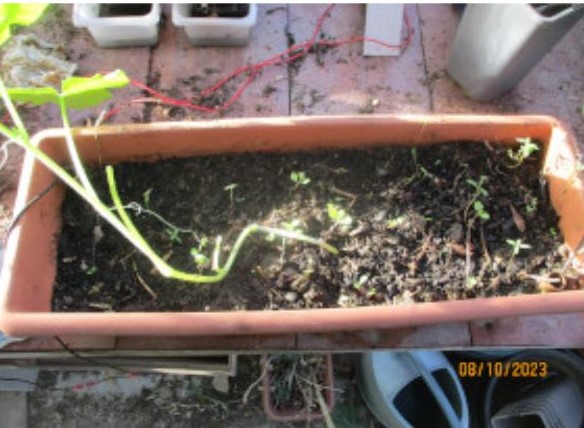
Electrocultivated tomatoes
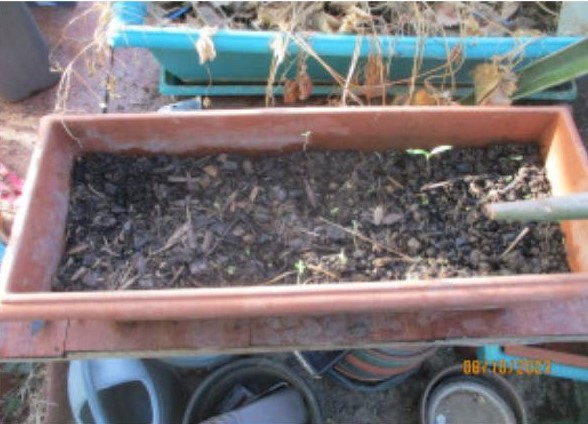
Standard control tomatoes
Disregard the leafy plant in the center planter
Likewise on 22 October, the seedlings developed significantly in the electroboosted planter, almost nonexistent in the electrocultivated planter and nil in the control planter.
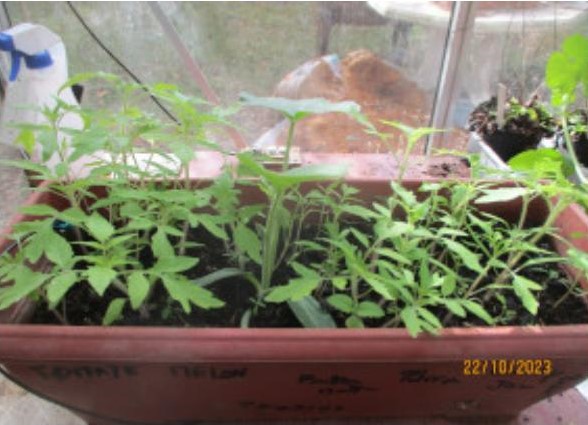
Electroboosted tomatoes
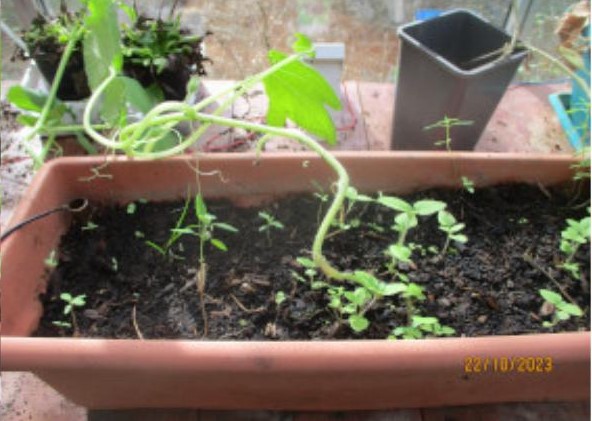
Electrocultivated tomatoes
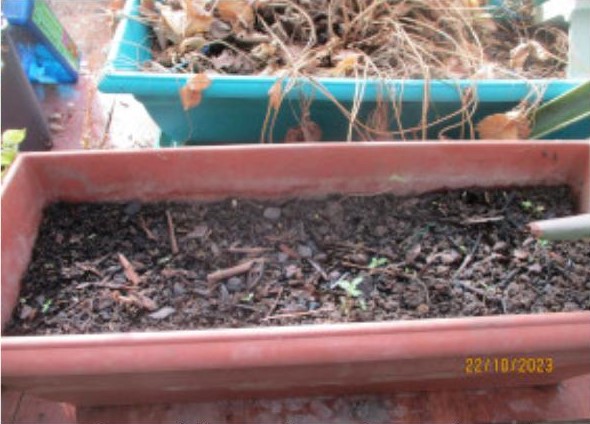
Standard control tomatoes
Disregard the leafy plant in the center planter
On 15 November, in the electroboosted planter, the seedlings continued their development, the same in the electrocultivated planter and nil in the control planter
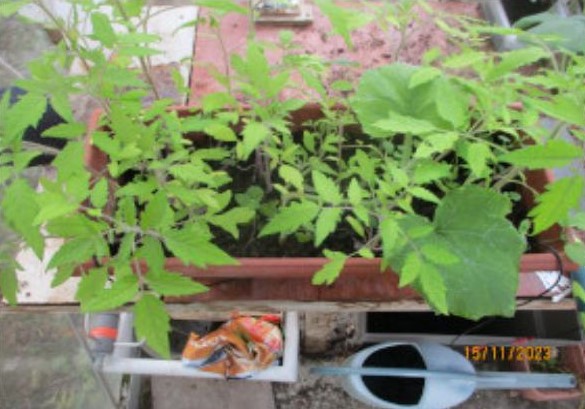
Electroboosted tomatoes
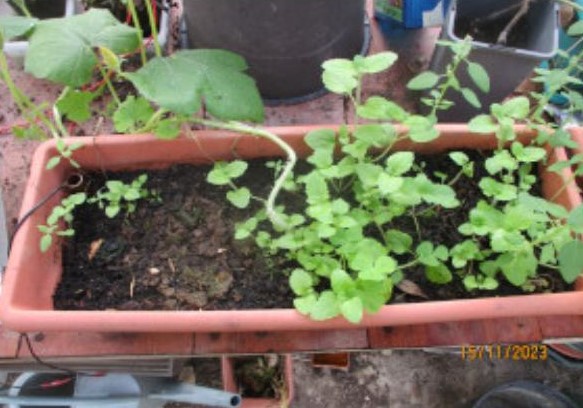
Electrocultivated tomatoes
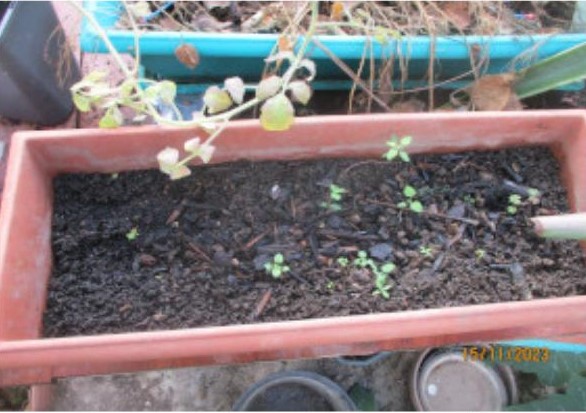
Standard control tomatoes
Disregard the leafy plant in the center planter
On 8 December, the temperature dropped to -1°C, which wiped out the electroboosted tomatoes, and the electrocultivated ones did not survive 5°C.
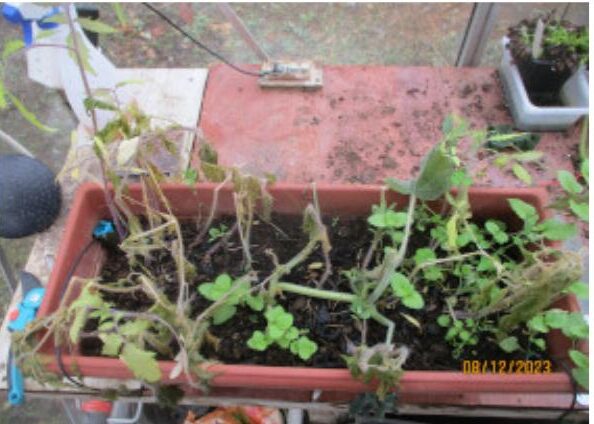
Electroboosted tomatoes
CONCLUSION:
The evolution of the 3 planters between 29 September and 8 December, a period when sunshine decreases and temperature swings increase, shows that the control planter does not allow the seeds to grow. The electrocultivated planter allows moderate growth down to 5°. The electroboosted planter shows normal growth down to 0°. This would make it possible to carry out autumn seedlings by lowering the greenhouse temperature to a few degrees at night. Significant heating savings could be achieved.